Start from a specific operational problem
Choose the demonstration scenario that is closest to the process currently creating the most friction, delay, or risk in your organisation.
Partner Program for Garment Manufacturers
Full free access to the Enterprise plan until 31 Dec 2026 • only for the first 20 companies
Explore how StitchOne can support different production and warehouse processes and identify where the system can create the most immediate operational value for your organisation.
Choose the demonstration scenario that is closest to the process currently creating the most friction, delay, or risk in your organisation.
The demonstrations are organised around real workflows so you can assess how the system behaves in practice rather than only reviewing isolated functions.
Use the scenarios to judge relevance for your documents, teams, reporting model, stock movements, and management-control requirements.
The demonstrations are organised around concrete operational processes, allowing you to assess how StitchOne fits the real structure of your production environment.
Start with the area that is most relevant to your current priority — production reporting, warehouse execution, traceability, OCR, or another workflow that requires stronger control or less manual effort.
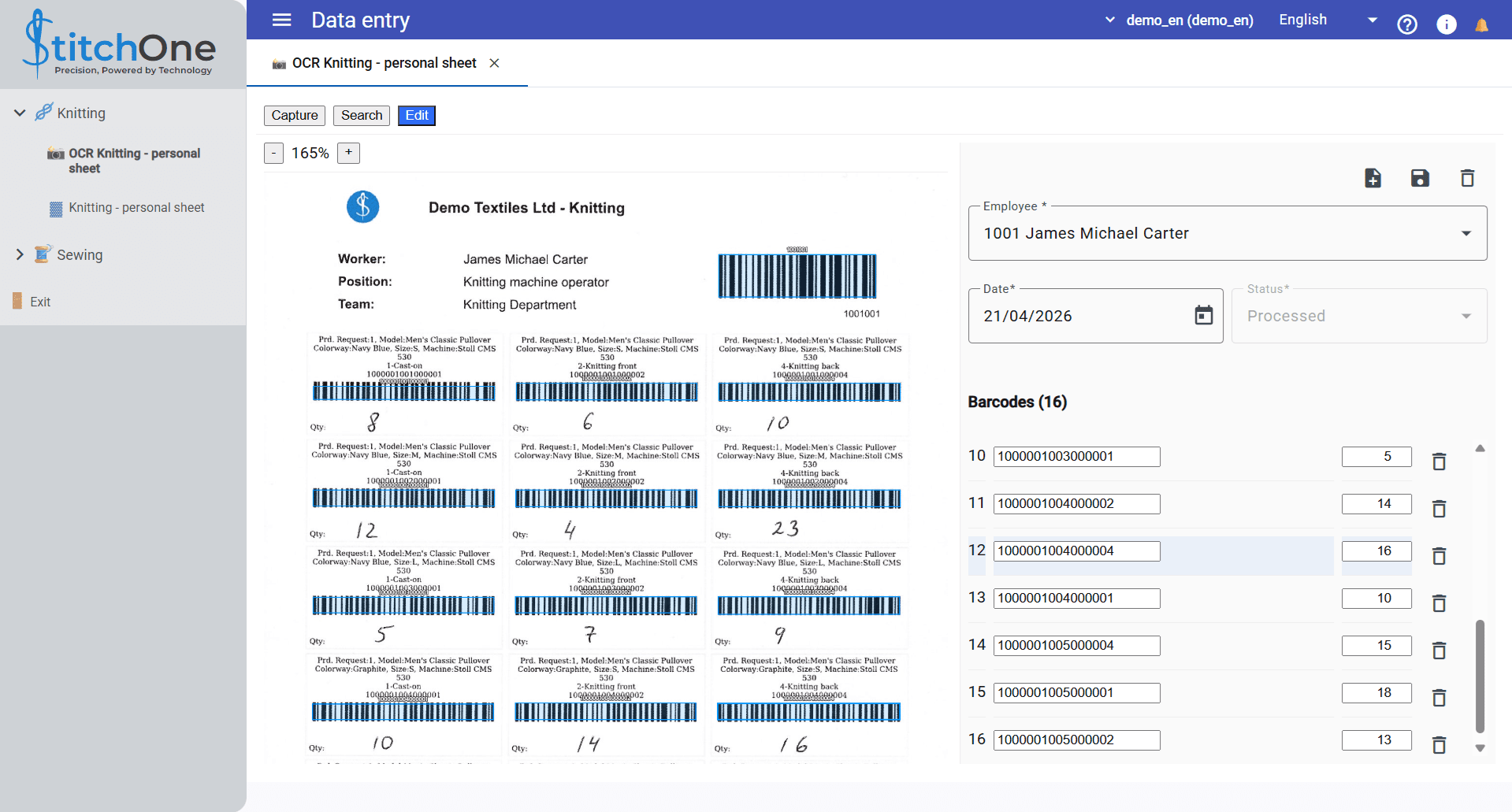 *real view
Suitable if you want to evaluate how handwritten production sheets, operation-level reporting, and barcode-linked execution data can be processed more efficiently and prepared for ERP use.
Suitable if you want to assess how barcode-supported warehouse execution can improve material identification, movement discipline, inventory reliability, and coordination with production.
Use the scenarios as a practical basis for evaluation — not only how the system looks, but how well it corresponds to your documents, roles, operational volume, and control model.
Select the scenario that reflects the current bottleneck, risk, or reporting weakness in your production environment.
Assess not only what the screen shows, but how information is captured, verified, linked, and made available to the wider operation.
Evaluate whether the demonstrated flow aligns with your actual documents, teams, volume, and control expectations.
If the scenario appears relevant, the next step is a targeted discussion, guided demonstration, or trial environment aligned with your context.
Regardless of whether the focus is production reporting or warehouse execution, the objective remains the same: transform day-to-day activity into timely, structured, and dependable ERP data.
Whether the source is a production sheet or a warehouse transaction, the purpose is the same: transform operational input into a structured ERP record connected to the right document, person, operation, and movement.
Start with the demonstration closest to your operational reality. If you see a clear fit, continue with a focused discussion, guided demonstration, or trial environment.