Control is harder without clear identifiers
When information moves between sheets, people, and departments without a stable structure, it becomes harder to track who reported what and when.
Partner Program for Garment Manufacturers
Full free access to the Enterprise plan until 31 Dec 2026 • only for the first 20 companies
When operations, workers, batches, and movements are linked more clearly through barcodes, production gains better traceability, fewer manual checks, and more reliable management data.
When information moves between sheets, people, and departments without a stable structure, it becomes harder to track who reported what and when.
Without strong traceability, it becomes easier for uncertainty to appear around a specific operation, operator, line, or production stage.
If it is difficult to quickly trace where a problem started, corrective action comes later and control becomes weaker.
Traceability in production is not simply a matter of having barcodes. The value appears when the barcode is part of a clear flow for identification, reporting, checking, and movement of information between stages.
In garment production, this usually means a clearer link between:
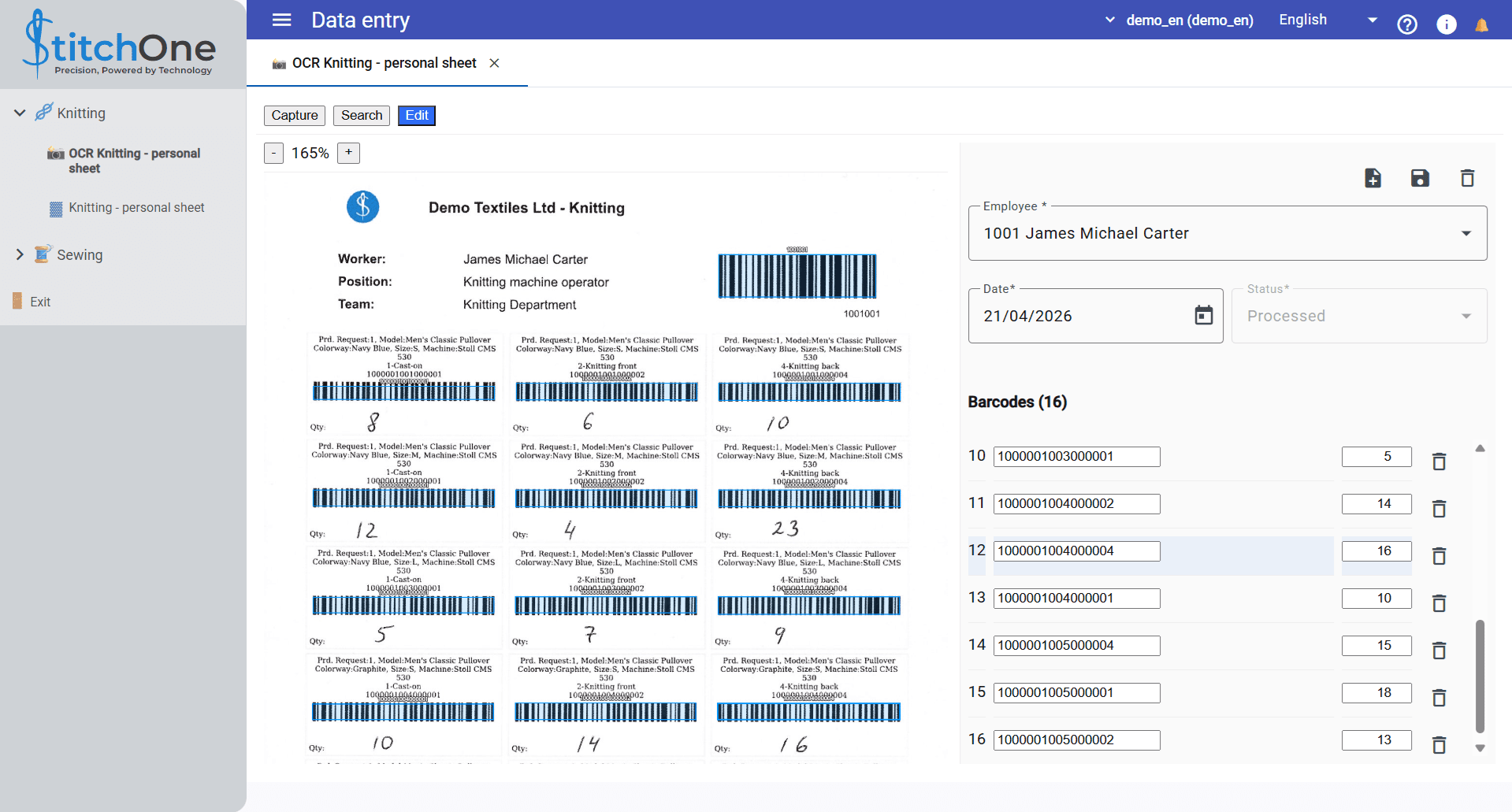 *real view
Even when some form of reporting exists, the absence of clear identifiers often makes checking slower and control weaker.
Without a clear identifier, extra checking is often needed to confirm whether the record belongs to the right operation.
When the link between the record and the worker is weak, worker-level traceability also becomes weaker.
Differences across batches, styles, and production documents are harder to trace without clear marking.
When movement between production, warehouse, and finished goods is not clearly marked, the control picture becomes slower and less complete.
The more clearly information is linked, the less time is lost in searching, checking, and repeated verification.
Each record should clearly show which operation it belongs to.
It should be clear who reported or completed the actual work.
The data needs to stay linked to the correct production document and task.
Traceability becomes stronger when the movement path by batch and stage is clear.
It should be easy to see not only what happened, but also in what volume and at which stage.
A barcode is not just a label. It is a fast and reliable way to connect data to the correct production context.
When operations, workers, or batches are marked with barcodes, the system connects information faster and with lower risk of error.
Barcodes do not replace the process — they give it a more stable foundation for identification and traceability.
Once identifiers are clear, the data becomes easier to use for operational control, reports, and follow-up decisions.
Traceability creates the greatest value when it is part of the overall ERP flow — not as a separate idea, but as a real foundation for control.
Barcodes are most useful when they are part of a real reporting, reading, and data-saving flow.
Traceability becomes more valuable when it is connected to material movements, warehouse operations, and stock visibility.
Control over finished items, batches, and shipment preparation also depends on solid traceability logic.
See how barcode reading fits into a real flow of data processing and preparation for ERP.
When identification in the production flow becomes clearer, teams spend less time on manual checking and more time on actual control.
This approach is most useful for companies that want better traceability and fewer manual checks between production, warehouse, and reporting.
When a shift includes many records, operations, and people, barcode traceability helps create a much clearer control picture.
Especially useful for teams that want better visibility by operation, worker, style, and batch.
When production and warehouse movements need to be seen as one connected process, strong barcode logic becomes essential.
If you are wondering whether barcode traceability would bring real value to your factory, ask yourself:
If these questions are creating daily friction, stronger traceability is probably no longer a nice-to-have — it has become an operational need.
We can show how a clearer link between operations, workers, batches, and movements would look in a real production context.