Spreadsheets are convenient at the start
For a smaller workload, spreadsheets often feel sufficient — easy to start with and requiring no new system.
Partner Program for Garment Manufacturers
Full free access to the Enterprise plan until 31 Dec 2026 • only for the first 20 companies
Spreadsheets are often the natural starting point. But when production grows, workflows become more connected, and teams depend on more timely data, a cloud ERP approach gives a much stronger foundation for control.
For a smaller workload, spreadsheets often feel sufficient — easy to start with and requiring no new system.
As people, operations, styles, and reports increase, manual coordination across files becomes harder.
When planning, reporting, warehouse work, and traceability operate in one environment, management becomes faster and more reliable.
Spreadsheets are a natural early-stage tool. They are easy to start with, require no implementation, and provide quick flexibility. That is why so many production companies begin there.
The problem is not that spreadsheets are bad. The problem is that as production volume, people, operations, movements, and traceability needs grow, they start requiring more and more manual coordination.
At some point, files stop being just a place to store information. They become a source of delay, repeated checking, and weaker management visibility.
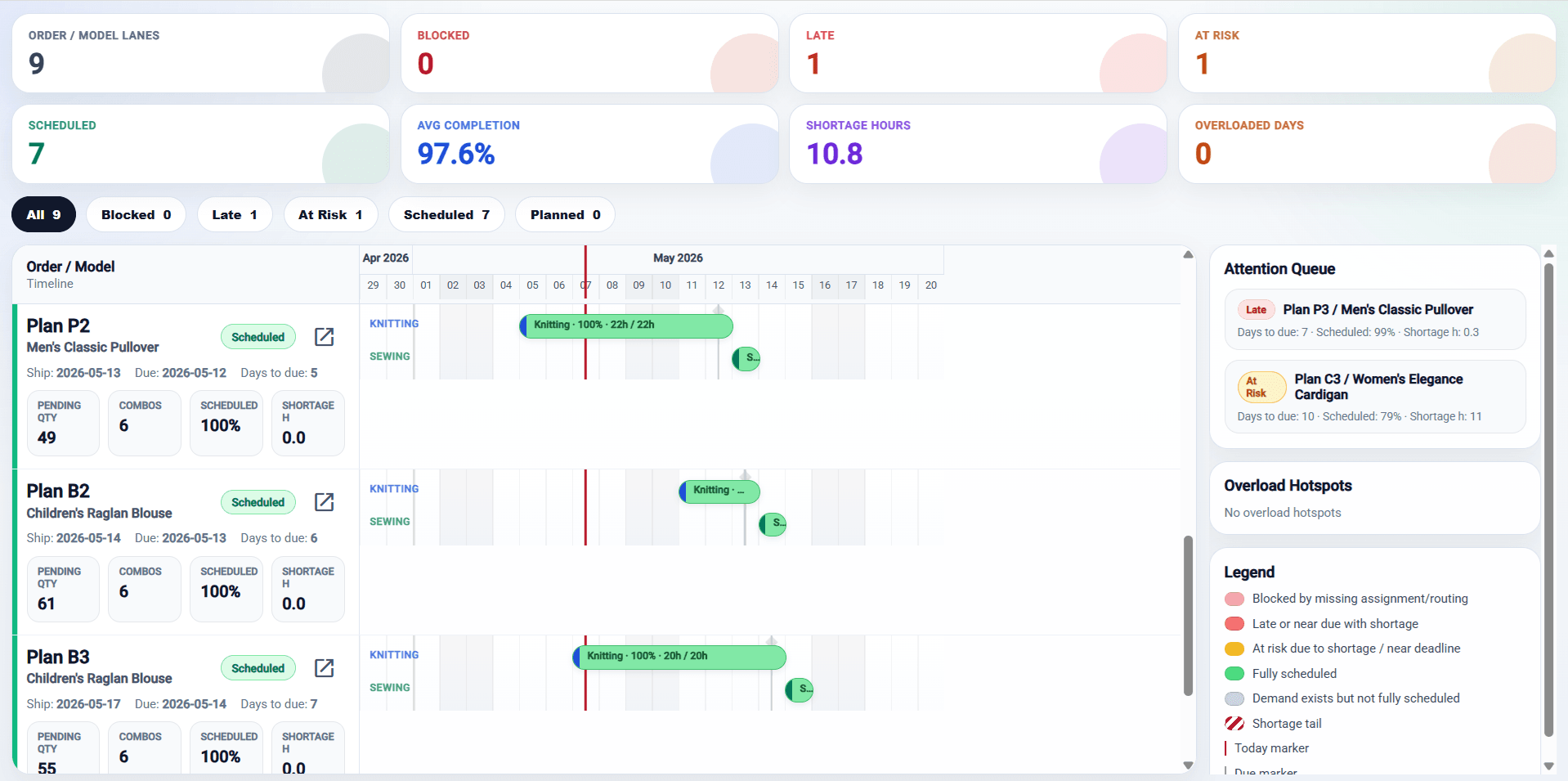 *real view
The more dependencies there are between workflows, the harder it becomes to keep information structured, synchronized, and easy to manage.
When more people work across similar spreadsheets, mismatches, manual merging, and uncertainty about which version is correct become common.
The more processes are split across spreadsheets, the more time is spent comparing orders, production, warehouse data, and reports.
Spreadsheets struggle to show a clear path by operation, worker, batch, and material movement, especially as volume increases.
If data comes from different files and is assembled manually, managers see the real picture later than they should.
The biggest difference is not just that the data lives “inside a system”, but that the workflows begin to operate with stronger, more connected logic.
Planning, reporting, warehouse activity, roles, and reports work in one connected environment, not across separate files and manual summaries.
Data can enter the system faster and become available immediately for traceability, KPIs, and management reporting.
When processes follow shared system logic, important information is less likely to be skipped or recorded in inconsistent ways.
Production, warehouse, and management work from the same picture instead of each department maintaining its own separate view.
Not every process needs ERP from day one. But when the need for control, traceability, and coordination grows, the difference becomes increasingly visible.
Usually done in separate files, with manual updates and additional checking between versions.
Runs in one environment with a better link to capacity, lines, shifts, and actual execution.
Requires more manual transfer, consolidation, and checking of data.
Makes it easier to capture production data and make it visible faster to the team.
Harder to see the full link between operation, worker, batch, and movement.
Supports a clearer connection between records, operations, materials, and production stages.
Often depend on manual summaries and separately prepared reports.
Data is more directly usable in reports, KPIs, and management analysis.
More dependence on sending files, different versions, and verbal clarifications.
Stronger shared visibility across production, warehouse, planning, and management.
Feel easy at the beginning, but become heavier as dependencies and process volume increase.
Requires a more structured environment, but gives a stronger foundation for growth and control.
StitchOne is built exactly for companies that want to move from fragmented file-based work to a more connected ERP environment without unnecessary complexity.
Useful if you want a better connection between capacity, lines, shifts, and actual execution.
When you want to reduce manual reporting and prepare production data faster for ERP recording.
For a stronger connection between production, materials, movements, and actual stock visibility.
See how a real workflow looks when data is prepared and used directly inside the ERP environment.
The most important question is not whether spreadsheets can still work, but when they start costing more time, more checking, and more organizational effort than they are worth.
Especially useful for companies that have already outgrown the “good enough” stage of spreadsheets and need a more connected system.
If files keep multiplying, reports take too much effort, and coordination slows down, spreadsheets are probably already limiting your workflow.
When there are more lines, more operations, more workers, and more movement between production and warehouse, a shared ERP environment becomes much more useful.
If decisions need to be made faster and based on more reliable data, the cloud ERP approach creates a strong advantage.
If you are wondering whether the time for a more structured system has come, ask yourself the following:
If these questions already describe your daily reality, the issue is probably not “one more spreadsheet”, but the fact that the spreadsheet-based model itself has become too heavy for a growing production environment.
We can talk through your current workflow, identify where spreadsheets are already slowing you down, and show what a more structured ERP approach would look like for your team.