Handwritten quantities
In many factories, operators and shift supervisors still work with production sheets where quantities are filled in by hand.
Partner Program for Garment Manufacturers
Full free access to the Enterprise plan until 31 Dec 2026 • only for the first 20 companies
See how OCR helps read handwritten quantities and production barcodes in sewing and knitting workflows — with less manual work, faster reporting, and better ERP-ready data.
In many factories, operators and shift supervisors still work with production sheets where quantities are filled in by hand.
Besides handwritten values, sheets often include barcodes for operations, workers, styles, batches, or internal identifiers.
The slower this information is transferred into the system, the later managers see the real production picture.
In production, OCR is not just about reading text. Its real value is turning information from a real work sheet into a structured result that is ready for review, correction, and saving.
In sewing and knitting, production sheets often contain handwritten quantities, barcodes, operation labels, worker identifiers, and internal production codes at the same time.
That is why the most useful OCR approach is not to read everything at any cost, but to prepare a reliable result that the team can review and confirm quickly.
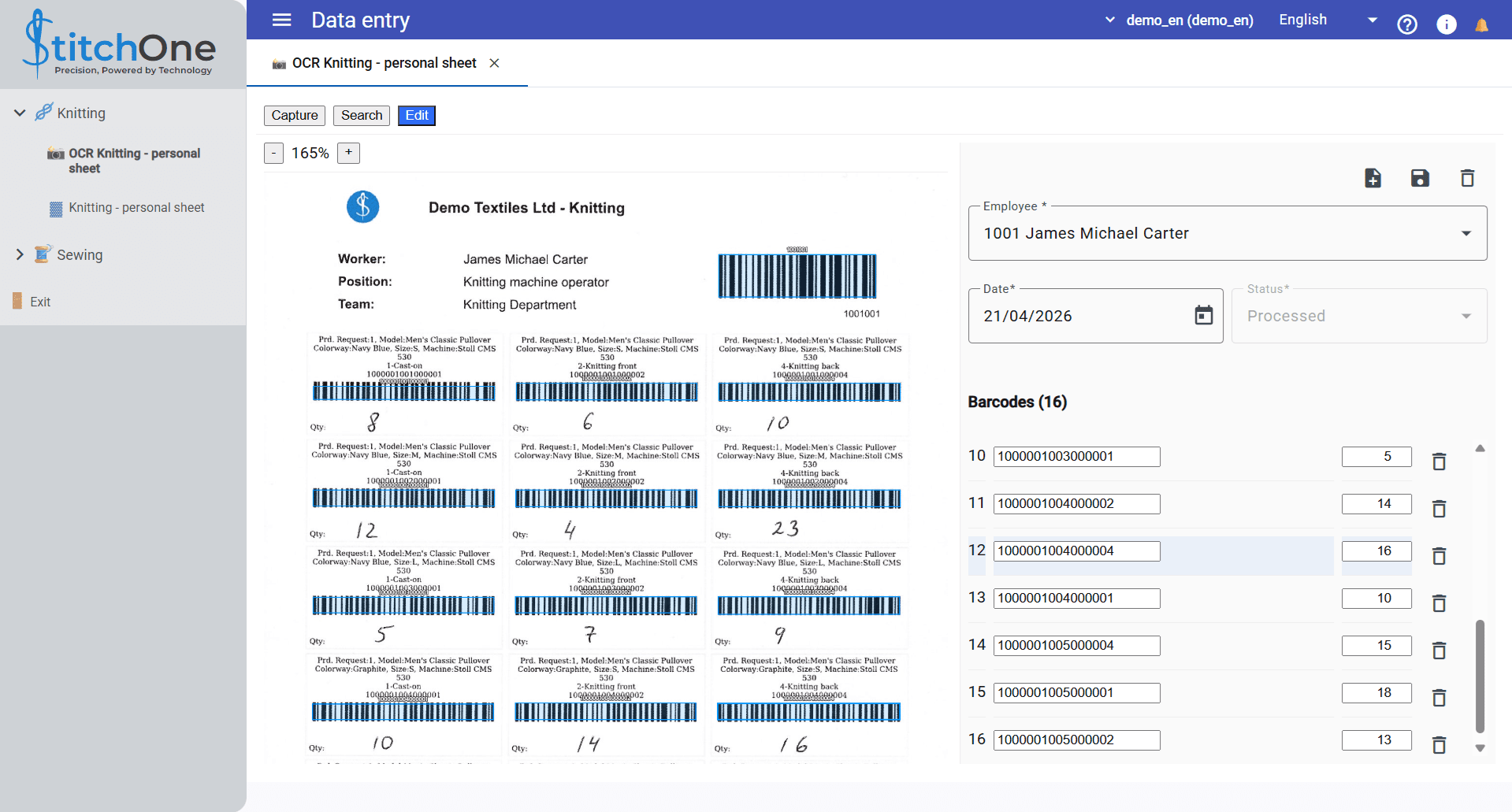 *real view
In production, it is not enough to just see numbers. What matters is connecting them to the right context and keeping the result under control before saving.
In a production context, OCR becomes useful when it turns handwritten data from a real work sheet into a structured result ready for review and saving.
It is not enough for the system to just detect digits. It needs to connect them to the right operation, worker, batch, and document context.
The strongest process is not blind auto-save, but OCR + verification + confirmation, so the team stays in control of the final result.
The best result comes when OCR is part of a clearer flow — from the sheet, through verification, to the final ERP record.
The system reads manually written values and prepares them for review.
Barcodes are detected and used to connect the sheet to the correct production records.
The sheet is treated not as free text, but as a structured production document.
A clear screen is prepared for the operator to confirm or correct only what is needed.
After confirmation, the data can be saved and used in reporting, KPIs, and traceability.
In production, the stronger approach is usually OCR + barcode + human review, not blind automatic saving.
If the process only reads numbers without context, there is still a risk that information will not be linked to the right operations and people.
Combining handwritten values with barcode identifiers gives a more reliable result and stronger traceability.
The best production process does not remove control — it removes repetitive manual work and leaves only the final check to the team.
Technology creates value when it is linked to a real process of review, saving, and using the data inside the ERP environment.
The public demo shows how handwritten quantities and production barcodes are processed on real production sheets.
See how the data capture module fits into ERP logic instead of acting as a separate standalone tool.
If you want a broader context, also explore how to reduce manual production reporting in the factory.
We can talk about your real sheets, operations, and reporting process — not only generic features.
When OCR is used correctly — as part of a real production flow — the effect is not simply more modern technology, but a much faster transition from paper to useful production data.
The benefit becomes most visible where there is more manual reporting, more sheets to process, and more pressure to close the shift quickly.
With denser sheets, more operations, and larger reporting volumes, OCR reduces the effort needed to read and record production data.
Where handwritten quantities and recurring reporting formats are common, OCR speeds up the preparation of data for ERP.
When different departments use different sheet formats, OCR helps gather more unified and more timely production information.
For good OCR results in production, it is not only the recognition engine that matters, but also the discipline in how sheets are prepared and filled in.
The best process combines well-prepared forms, OCR, barcodes, and a fast human review before saving.
Explore the demo or request a discussion so we can talk about your actual sewing, knitting, operations, workers, and reporting flow.