Paper sheets create delays
When reporting starts on paper and ends with manual transfer, shifts close more slowly and useful information reaches managers later.
Partner Program for Garment Manufacturers
Full free access to the Enterprise plan until 31 Dec 2026 • only for the first 20 companies
If your team is still manually re-entering data from paper production sheets, this slows reporting down, increases the risk of mistakes, and makes management harder. Here is how the process can become faster, more structured, and more reliable.
When reporting starts on paper and ends with manual transfer, shifts close more slowly and useful information reaches managers later.
Shift supervisors and production leaders spend time collecting, reading, and checking data instead of managing the actual production flow.
Manual re-entry creates gaps, incorrect quantities, and mismatches across operations, workers, and batches.
In many factories, reporting still goes through several manual steps. Work is recorded on paper, then someone has to review the sheets, read the handwriting, check the barcodes, and finally re-enter everything into a spreadsheet or ERP system.
At first glance, this may look like normal administrative work. In reality, this is exactly where delays build up, supervisors lose time, and mistakes appear in quantities, operations, and records.
The more manual steps exist between the paper sheet and the final ERP record, the greater the chance that data arrives too late or is not reliable enough for management use.
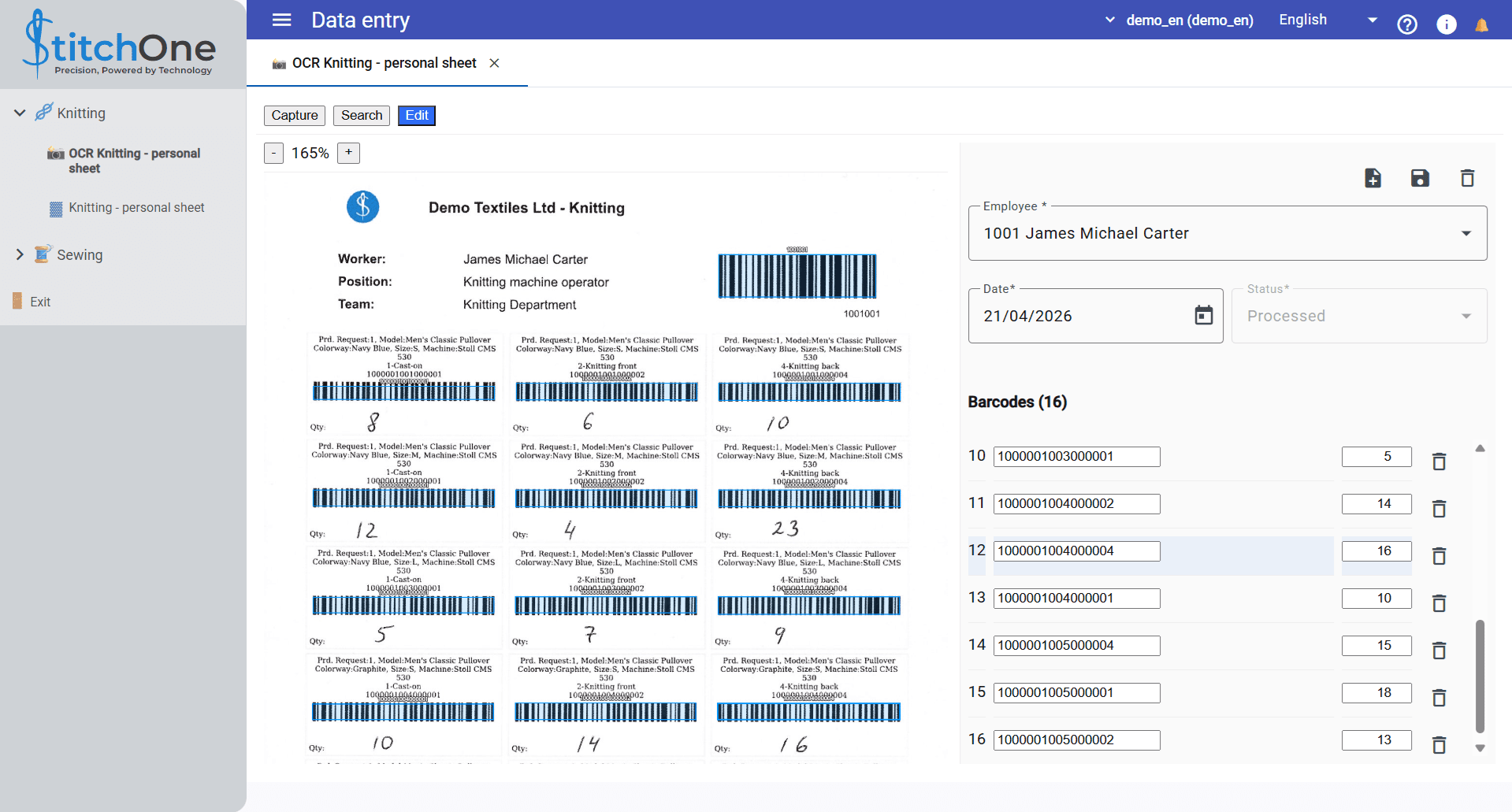 *real view
This is not only about lost time. Manual reporting affects reaction speed, data reliability, and control over execution.
When data enters the system late, reaction to delays, overload, or issues at a specific operation also comes too late.
Filling in, reviewing, reading, and retyping data adds workload and makes reporting dependent on extra administrative time.
It becomes harder to see which worker reported what, for which operation, style, or batch.
Even small mistakes in manual transfer affect KPIs, management reports, and planning decisions.
A better process does not mean more complexity. In most cases it means fewer manual steps and a faster move from paper to useful data.
The production sheet is captured using a phone or tablet instead of being manually re-entered line by line.
The system reads handwritten values and prepares the result for verification.
Operations, workers, and batches are linked faster and more accurately through barcode detection.
The operator corrects only what is necessary instead of typing everything from scratch.
After confirmation, the information is saved and immediately available for reports, KPIs, and management use.
StitchOne is built for real production workflows and addresses exactly the problem of slow, heavy, manual reporting.
Read handwritten quantities and production barcodes as part of the real reporting flow.
Better reporting creates even more value when it is connected to planning, lines, capacity, and execution.
More timely data also improves warehouse workflows, inventory visibility, and control over movements.
Work directly in the browser without local servers and without a heavy implementation project at the start.
The real question is not just what the technology looks like, but what changes for the team in daily work. With a better reporting process, the value appears in faster reaction, more trustworthy reports, and less administrative pressure.
This approach is especially useful for companies that still rely on paper sheets, have heavy shift reporting, and want better visibility without a heavy implementation project.
Especially useful for teams that still rely on paper and want faster digital reporting without making shop-floor work more complex.
When the end of the shift includes many sheets, many operations, and a lot of manual checking, every saved step makes a difference.
A good fit for companies that want more timely execution data, better traceability, and easier coordination between production, planning, and warehouse operations.
If you still rely on paper sheets and manual re-entry, ask yourself a few simple questions:
If these questions are creating daily friction, manual reporting is probably already holding your production back.
Explore the demo or send us a specific question about your workflow. We can show how faster reporting would look in the way your team really works.