Unambiguous material identification
Barcode identification reduces ambiguity across materials, colours, batches, and locations, giving warehouse teams a consistent reference point for every transaction.
Partner Program for Garment Manufacturers
Full free access to the Enterprise plan until 31 Dec 2026 • only for the first 20 companies
A structured warehouse approach for garment manufacturing: clearer material identification, more accurate stock movements, stronger inventory integrity, and better responsiveness between warehouse and production.
Barcode identification reduces ambiguity across materials, colours, batches, and locations, giving warehouse teams a consistent reference point for every transaction.
Goods receipts, issues, returns, and transfers can be recorded with fewer manual steps and greater confidence in the resulting stock data.
When stock movements are reflected promptly and consistently, production planning works from current inventory reality rather than assumptions.
In warehouse operations, inefficiency rarely comes from one major error. More often, it comes from many small frictions — searching for the correct material, rechecking similar items, validating batches and quantities again, and reflecting stock movements too late.
When these actions repeat daily, the cumulative effect is significant: warehouse teams carry more pressure, production support becomes less predictable, and inventory records become less dependable.
Barcode-driven execution creates value exactly at this point — not as an isolated feature, but as a standard for consistency, transaction discipline, and more reliable operational control.
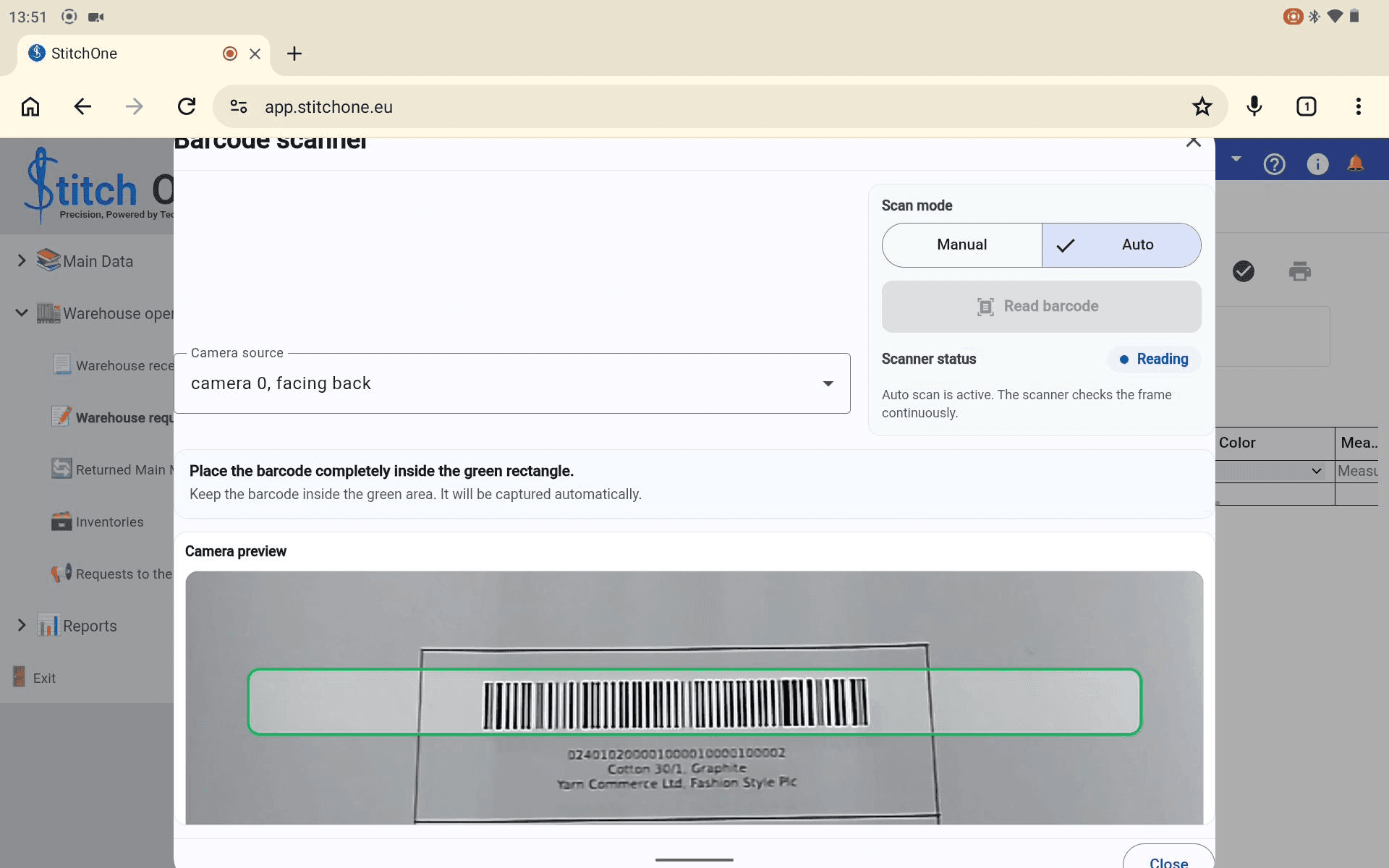 *real view
Where identification and recording are not standardized, warehouse teams spend more time validating, correcting, and reconciling.
Where the material portfolio is broad and variants are similar, even short manual checks accumulate into measurable time loss.
If identification is not sufficiently clear, additional verification becomes routine and warehouse execution slows down.
Late or incomplete movement recording makes it more likely that stock discrepancies will surface later, when the operational impact is already greater.
Without reliable movement data, it becomes more difficult to control availability, material consumption, and operational risk across the production flow.
The objective is not only speed. It is stronger transaction discipline, better inventory integrity, and more dependable data for operational and management use.
Barcode-supported handling creates a shared operational discipline across people, shifts, and storage areas.
When transactions are identified and recorded at the point of execution, data quality improves and downstream corrections decrease.
Accurate movement capture creates a more trustworthy stock position for production support, stock counts, and management reporting.
The operational impact comes from combining identification, transaction discipline, and timely recording — not from a single technical step in isolation.
Materials, batches, and locations are identified through a consistent labeling approach that reduces ambiguity at the transaction level.
Receipts, issues, returns, and transfers are reflected with fewer manual actions and a clearer operational context.
When movements are recorded promptly, discrepancies become visible earlier and can be resolved before they disrupt production.
Warehouse teams can respond to material requests more predictably when the stock picture is current and movements are structured.
Reliable warehouse records support traceability, stock reconciliation, internal control, and management reporting with less effort.
The greatest value appears where complexity, movement volume, and control requirements are already high.
Where warehouses handle many item variants, colours, trims, and batches, a standardized identification model becomes operationally essential.
Where issues, returns, and internal transfers are frequent, faster and clearer recording has a direct effect on accuracy and speed.
Especially useful where stronger traceability, cleaner stock reporting, and more disciplined warehouse execution are becoming management priorities.
The strongest result comes when warehouse work, production, and reporting operate inside one connected ERP logic — with stronger traceability and consistent transaction rules.
Maintain current stock visibility, movement history, and traceability as part of a connected ERP environment.
Barcode logic becomes even more valuable when reporting, reading, and data preparation are part of one consistent process.
Better warehouse data directly supports more reliable planning, material requests, and execution control.
The same identification logic also strengthens batch-level control over finished products, stock, and shipment preparation.
With a well-implemented barcode-based warehouse model, manual validation decreases, movement execution accelerates, and data reliability improves. The effect is felt both in the warehouse itself and in how production is served.
A strong fit for manufacturers that need tighter stock accuracy, stronger traceability, and more scalable warehouse processes.
Where a material error can affect deadlines, continuity, or cost, stronger warehouse execution becomes a strategic requirement.
Where production continuity depends on timely and accurate warehouse support, current stock and movement visibility matter every day.
A barcode-supported model helps create stronger process discipline, better stock integrity, and more scalable warehouse operations.
If you want to understand whether barcode-supported warehouse execution would create measurable operational value, start with these questions:
If several of these questions reflect your daily reality, there is likely substantial potential for improvement — both in execution speed and in the quality of warehouse data used across the business.
Start a free trial or request a guided demo to evaluate barcode-driven warehouse execution in your real environment — movements, inventory visibility, and traceability included.